


A few years ago I picked up a book: A Killer by Design by Ann Wolbert Burgess and devoured it quickly with awe. Ann Burgess was one of the first women in the FBI's Behavioral Science Unit that studied the minds of sexual serial killers. She was instrumental in gathering the information we now know about serial killers and how they think, pick victims and process their crimes. But it took decades for the world to recognize her work.
Ann Wolbert Burgess went into a line of work that I do not have the stomach for at all. The thought of sitting across from a serial rapist or serial killer and listening to them recount their crimes is just not something I could do but I'm glad that people like her exist. We cant know how many lives were saved by criminal profilers thanks in large to Burgess and her amazing mind.
Her FBI journey began in 1975 with two FBI agents who were driving across America with a trunk full of taped confessions from serial killers. They had sat in prison cells with the worst people the country had ever produced to record the stories of their criminal offenses. They had shaken hands with men who did unspeakable things and asked them, politely, to explain themselves. But they weren’t sure what to do with their findings.
Burgess, then a 42-year-old nursing professor from Boston College, had not come to Quantico to revolutionize criminal justice. She had come to give one lecture about rape victimology, based on a clinical paper she’d published in 1973. One of the FBI agents read it and thought, correctly, that they needed her brain in the room. She gave the lecture. She looked at their interview methodology. And then she got to work.
When they played the recordings for her, she listened carefully and said something that must have felt like being told your masterpiece is arubbish. She stated plainly, “This isn’t research. This is just stories.”
She wasn’t being cruel, she was being precise giving her professional opinion. Every interview had different questions. She pointed out that there was no structured methodology, and no comparable data points. The killers had performed brilliantly, controlling every conversation, feeding the agents whatever kept things interesting. The agents had hours of tape and, scientifically speaking, almost nothing to show for it.
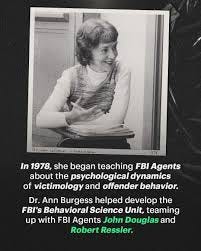
Her central insight sounds almost obvious in retrospect, which is the hallmark of genuinely good thinking. The agents had been so focused on killers that they had barely studied the people those killers chose. Burgess asked them to flip it entirely. Who were the victims? Where were they when they were approached? What did the offender say to gain compliance? What was the selection logic? She wanted to get into their minds to see why a person could become a mark.
She said in a USA Today interview: "I brought, I hope, victimology to better understand why these criminals were focusing in on the victim. It's not from the standpoint of the victim and what she's doing and wearing all that kind of mythology, but it's what's going on with the offender that I think is so important, why he's interested in the victim." Just brilliant!
This was not a hunch for Burgess. It came from six years of interviewing rape survivors, documenting trauma phases, mapping psychological responses to violence. She had already proven in academic literature that sexual violence was not about desire but about power. Now she applied that framework to murder and, in doing so, gave profiling its scientific spine.
She rebuilt the way investigators conduct interviews from the ground up. She created standardized questions so that information from different cases could actually be compared side by side. She put the victim in the center of the process, understanding who was targeted and why became the key to understanding the killer.
She also drew a clear line between two things that are easy to confuse: how a killer operates (which changes as they get smarter) and the deeper psychological need driving them (which never changes). She tracked how crimes get worse over time. And she reframed why victims didn’t resist; not as weakness, but as a reasonable survival instinct in an impossible situation.
In 1983, the methodology got its sharpest test. Boys were disappearing in Nebraska. Burgess was brought in to lead the profile analysis, studying victim demographics, wound patterns, location logic. The profile her work produced was specific: young white male, slight build, trusted position with children, likely a scout leader or coach, who would collect detective magazines and keep souvenirs, he most likely would have a history of overlooked minor offenses.
Police found John Joseph Joubert IV. Twenty years old. Assistant scoutmaster. In his possession, a detective magazine with a page marked showing a boy being abducted.
The Behavioral Science Unit went from fringe operation to legitimate investigative force essentially overnight. The case made it all the way to Congress. It also made national headlines, yet nearly every article credited Ressler and Douglas. Burgess’s name appeared once or twice, somewhere toward the bottom despite this being her now proven methodology.
This became the standard arrangement. She co-authored Sexual Homicide: Patterns and Motives in 1988 and the Crime Classification Manual in 1992. Both are still used by law enforcement worldwide. When the story got told publicly, it starred brilliant FBI agents cracking the code of criminal minds. The nurse who built the methodology, designed the science, and introduced the concept of victimology as the key to profiling was, reliably and regretably, a footnote. A victim of the patriarchy.
But then came Mindhunter, John Douglas’s 1995 memoir, which became a bestseller. Netflix adapted it in 2017 to considerable acclaim. The show included a character based on Burgess called Dr. Wendy Carr. They made her a psychologist because, as it was then explained, audiences wouldn’t understand nursing. They made her a lesbian. Childless. Someone who uprooted her career to relocate to Quantico. That character was everything Ann Burgess was NOT.
The real Ann Burgess was married with three children and had consulted from Boston while maintaining her full academic position at Boston College. She had not moved anywhere.
For years after the series aired, people approached Burgess at conferences with earnest sympathy about how difficult it must have been to be closeted in the FBI in the 1970s. She would explain, patiently, that she was not gay, had not lived in Quantico, was not a psychologist, was a psychiatric nurse, and had three children.
Consider what she actually built. She coined the term “rape trauma syndrome,” now recognized in over 300 court decisions, at a time when the legal system formally denied that rape caused lasting psychological damage. She testified as an expert witness in hundreds of cases including the Menendez trial. She published over 150 academic articles. She chaired the National Research Council’s Task Force on Violence Against Women and served on the National Academy of Sciences Institute of Medicine.
She did not publish her own account of any of this until 2021, when she was 85 years old. And that was the book I bought: A Killer by Design. In 2024, Hulu released a docuseries, Mastermind: To Think Like a Killer, that finally placed her where she had always been and deserved to be, at the center.
And yet people were surprised. I certainly was. I had watched the Mindhunter show, read the books, absorbed the cultural mythology of criminal profiling. I had not known a real woman was present and unaccounted for.
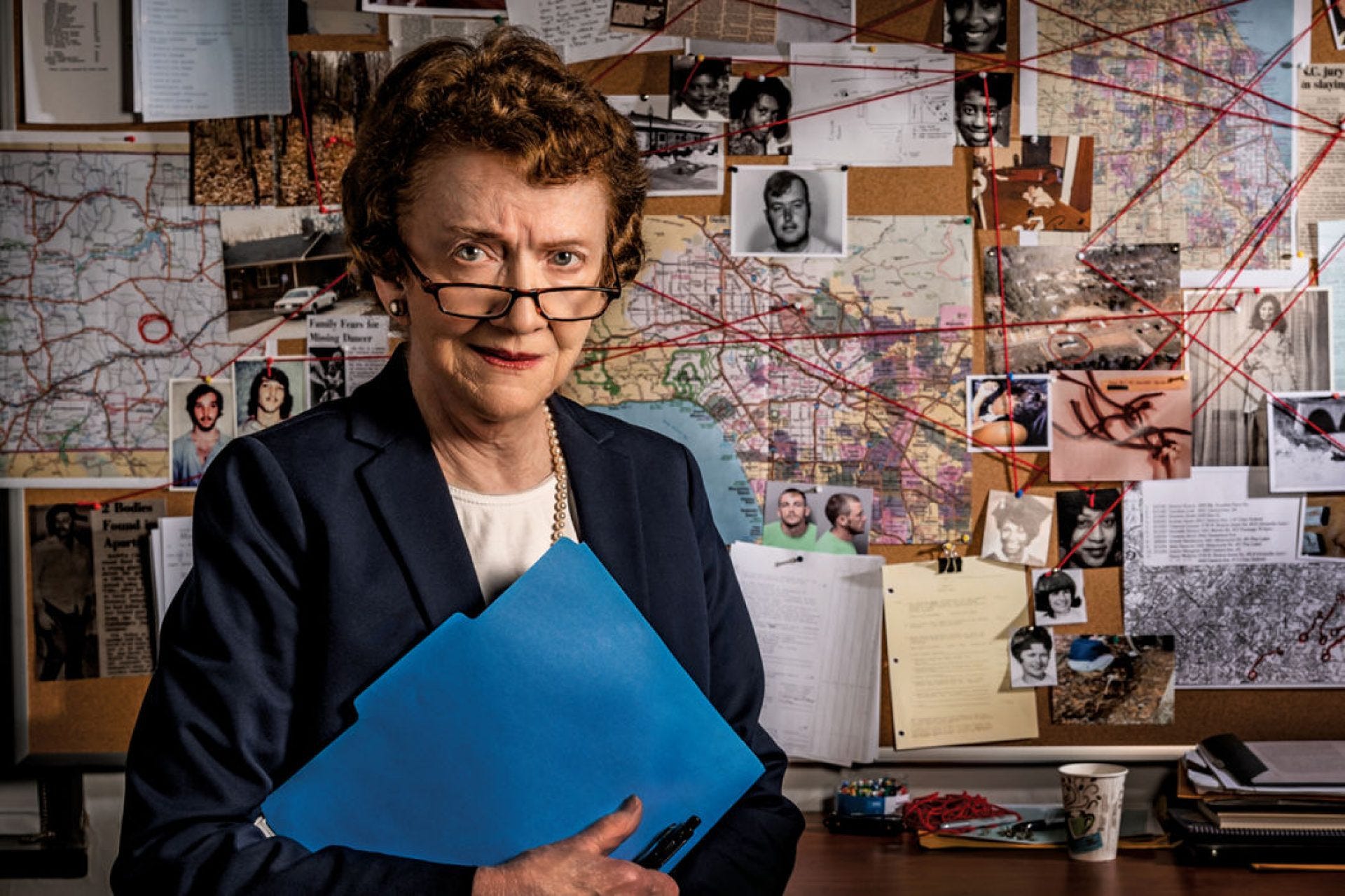
Ann Burgess is now 89 years old. She is still teaching at Boston College. Still publishing. Still consulting. What an inspiration!
Well this came at the right time...as I'm finally resurrecting a novel I started in 2016 that revolves around this very thing....And as another commenter says: 89 and still working! I hope I can follow suit. I didn't watch/reach Mindhunter, but will put those on the "research" list along with Burgess' memoir. Thanks for this...
Thank you for finding these influential women who should not be forgotten!