


In 1994, an 86-year-old woman sat down with a journalist named John de St. Jorre and admitted something she had spent four decades denying. She was Pauline Réage. She had written Story of O.
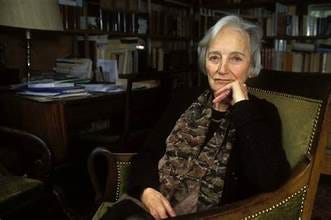
Her real name was Anne Desclos, though by then most of literary Paris knew her as Dominique Aury, the formidable editor and critic who had spent twenty-five years at the Nouvelle Revue Française, who sat on the jury for the Prix Femina, who had translated Virginia Woolf and T. S. Eliot into French and introduced French readers to Evelyn Waugh. She was undeniably the picture of the demure literary establishment figure. She did not seem to be the kind of woman who could write erotica.
She told the story of how the Story of O came to be for the first time. It all came down to a bet. Her lover, Jean Paulhan, an admirer of the Marquis de Sade and one of the most powerful men in French publishing, remarked to her that no woman was capable of writing a genuinely erotic novel. Desclos set out to prove him wrong. What she produced instead was one of the most controversial books of the twentieth century, a novel about a young woman’s total submission to her lover and to the men of a secluded château at Roissy, written in prose so controlled and so elegant that when it was published in 1954, almost no one believed a woman could have written it.
That disbelief speaks volumes, because it tells you something about how narrowly people were willing to imagine women’s interior lives at the time, and if we’re being honest, still are. The assumption was that a woman could not conceive of desire this frank, this transgressive, this structured. Desclos wrote the book as, in her own account, a kind of extended love letter to Paulhan, and the writing itself became an argument that the imagination has no fixed gender, that a woman’s inner life could hold exactly the same darkness, discipline, and hunger that men had always been permitted to claim as their own literary territory. It was revolutionary in it’s thinking that women could be lustful, sexually charged and write about it with elegance.
The book won the Prix des Deux Magots in January 1955. It also drew obscenity charges against its publisher, Jean-Jacques Pauvert, and a ban on advertising and selling it to minors that held until 1967. Réage’s identity remained a closely guarded secret through all of it. For a woman who had built a serious literary reputation under her own name and under Aury, the anonymity was not incidental. It was the entire architecture of the thing to protect her professional and private life.
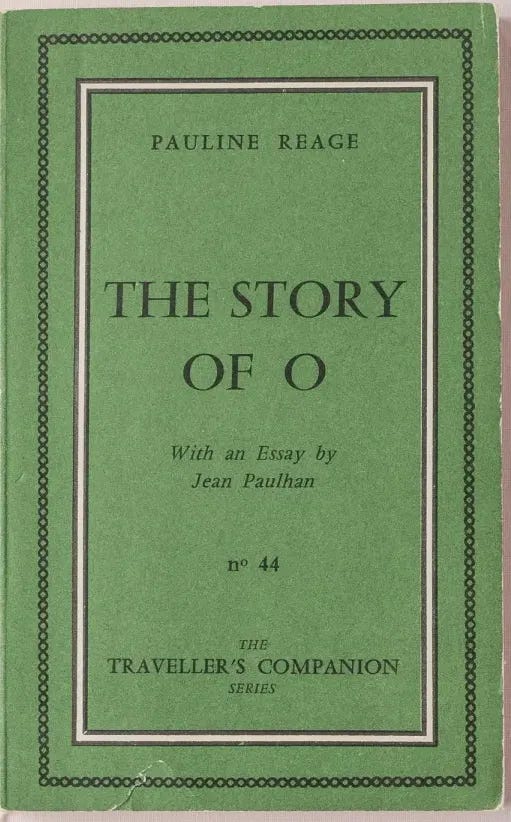
What strikes me most about Desclos is not the book itself but the sheer discipline of anonymity. She did not simply publish under a pseudonym the way any writer might. She built an entire second identity and kept it sealed off from her first one for forty years, through the obscenity trial, through the book’s translation into a dozen languages, through a sequel she did not even write herself, through a 1975 interview about erotic literature in which she discussed Story of O at length while no one knew she was the actual writer.
Consider what that required and the kind of strength it took to remain silent through the praise, awards, controversy and success. Every review, every rumor, every guess at the author’s identity, most of them assuming a man, had to be observed in silence by the woman who knew the truth and had decided, deliberately and repeatedly, not to correct the record. She was not hiding out of shame, or at least that is what she claimed. She seems to have understood, with real clarity, that the book’s authority depended partly on its mystery, and that revealing herself would change how the novel was read and how she herself would be read afterward, both as a woman and as the editor whose judgment other writers depended on.
There are those that felt her use of a pseudonym as simply strategic, a shield for a respectable woman doing disreputable work. I think that undersells what Desclos did. She did not write in secret because she thought the work unworthy of her name. She wrote in secret because she understood, better than most of her contemporaries, that the name attached to a book changes the book, and she wanted Story of O to exist on its own terms before it became inseparable from her biography.
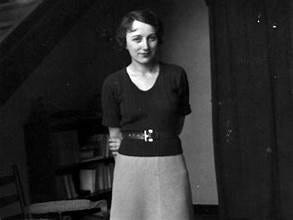
I want to be honest about the part of this history that does not resolve neatly, because pretending otherwise would not serve the book or the woman who wrote it. Story of O has been read for seventy years now as a story of a woman’s total erotic submission, and feminist critics have never agreed on what to make of that. Some have read the novel as a document of women’s oppression dressed in beautiful sentences. Others, including some prominent feminist critics and BDSM advocates, have argued that a woman writing her own fantasy of submission, on her own terms, in her own voice, is itself a form of authorship and control that the moralizing reading misses entirely.
I do not think there is a tidy answer here, and I am suspicious of any essay that pretends to give you one. What I find more interesting than the argument itself is the fact that both readings depend on the same premise, that a woman’s desire, however uncomfortable, is worth taking seriously as literature rather than dismissing as either pornography or false consciousness. Desclos forced that argument to happen by refusing to let the book be read as anything other than serious. The prose is spare and exact. There is no titillation for its own sake in the structure of the sentences, whatever one makes of the content they express. That control is itself the argument.
Why She Belongs in This Series
I keep coming back, in this Substack, to women whose real work got buried under something louder, something more marketable, something easier to summarize. Desclos is a slightly different case, because she was never obscure. She was decorated with the Légion d’honneur. Her editorial judgment shaped what got published in French literature for a generation. But almost none of that reputation traveled with her name to Story of O, and for forty years the two halves of her professional life ran on separate tracks, each unaware, at least publicly, of the other.
What I find most instructive for anyone writing today is not the scandal but the patience. Desclos wrote a book she knew would outlast the conditions of its own publication, and she was willing to let it exist without her name attached for longer than most of us keep anything private at all. That kind of restraint is nearly extinct now, when the instinct is to attach your name to everything the moment it leaves your hands. She understood that a book can be more honest when the writer is willing to disappear behind it, at least for a while.
She died in 1998, four years after the reveal, having spent most of her life letting one name do the respectable work and another carry the risk. It is worth asking, reading her now, which of those names actually told the truth about her. This is a question I think we’ll never know the answer to.
You can read more about Anne Desclos and listen to part of the Story of O here. You can also watch the controversial making of the 1970’s movie here.
Fascinating literary history. It's so interesting to me how feminist lit crit treats erotica, especially BDSM which is so steeped in radical consent. I make reference to the Story of O in my novel, but I wonder if many younger readers of dark romance know it. I don't like the dubcon trend, but I try to understand it.
Terrific post. As a psychologist trained in the early years of sex therapy, of course I read The Story of O, but I don't think I ever really knew the story of its author. Compare her literary chops to the sloppy prose of Fifty Shades of Gray! O my inner goddess!