


As promised, I decided to showcase innovative and inspiring women who have made a significant difference in our lives. I’m starting with someone I only learned about once her obituary was printed in 2018 in the New York Times. I had no idea what an impact her invention would make on my early writing life.
My first reaction to reading her story was, “Huh? That was invented by a woman? Why didn’t I know that?” The reason being, because she was a woman who succeeded in a man’s world despite the odds it wasn’t highlighted. Which is why I’m delighted to showcase her genius here today. And because there is something deliciously poetic about one of the most quietly revolutionary inventions of the twentieth century came from a woman whose job required her to be impossibly perfect.
In the 1950s, long before autocorrect, spell check, and backspace keys, a single typo on a typewriter could mean retyping an entire page. Imagine the pressure of having to type on carbon copies so it could be duplicated (anyone else remember the smell of those purple pages?). Imagine having your boss intimidatingly hovering over you waiting for it to be finished, duplicated, and then distributed. Just one small slip of a finger and the whole thing had to be redone. That was a lot of pressure for anyone. And it was that strive for perfection that inspired Bette Nesmith Graham to change everything.
Bette was a secretary at Texas Bank and Trust in Dallas. She was also a single mother in an era when that came with judgement, financial strain, and very little margin for error. Secretarial work was considered women’s work, invisible, hidden but replaceable work. You had to be perfect or you would be replaced.
But Bette was observant. She took on extra work painting the office window signs and realized if she made a mistake, she could simply paint over it, instead of starting over. This lead to her lightbulb moment that changed the secretary pool forever: Why can’t this work for typing too?
She went home to her kitchen, experimented with tempera paints to match her office paper. After a few attempts, she mixed up a perfect batch, poured it into a small bottle, and brought it along with a watercolor brush to work. When she made a typo, she painted over it, waited for it to dry, and retyped the correct letter. It was simple, effective and groundbreaking. It was also revolutionary and took a tremendous amount of stress off. Her colleagues took notice and started ordering bottle of their own. Soon enough, the word spread and Bette was bottling jars in her kitchen at night, labeling it by hand. She filled nail polish bottles to sell, hiring her son and his friends to handling bottling. She called it, “Mistake Out.”
But in 1958, Bette made a mistake at work. She accidentally signed an official office document as her Mistake Out company. Her boss was not amused and she was unceremoniously fired.
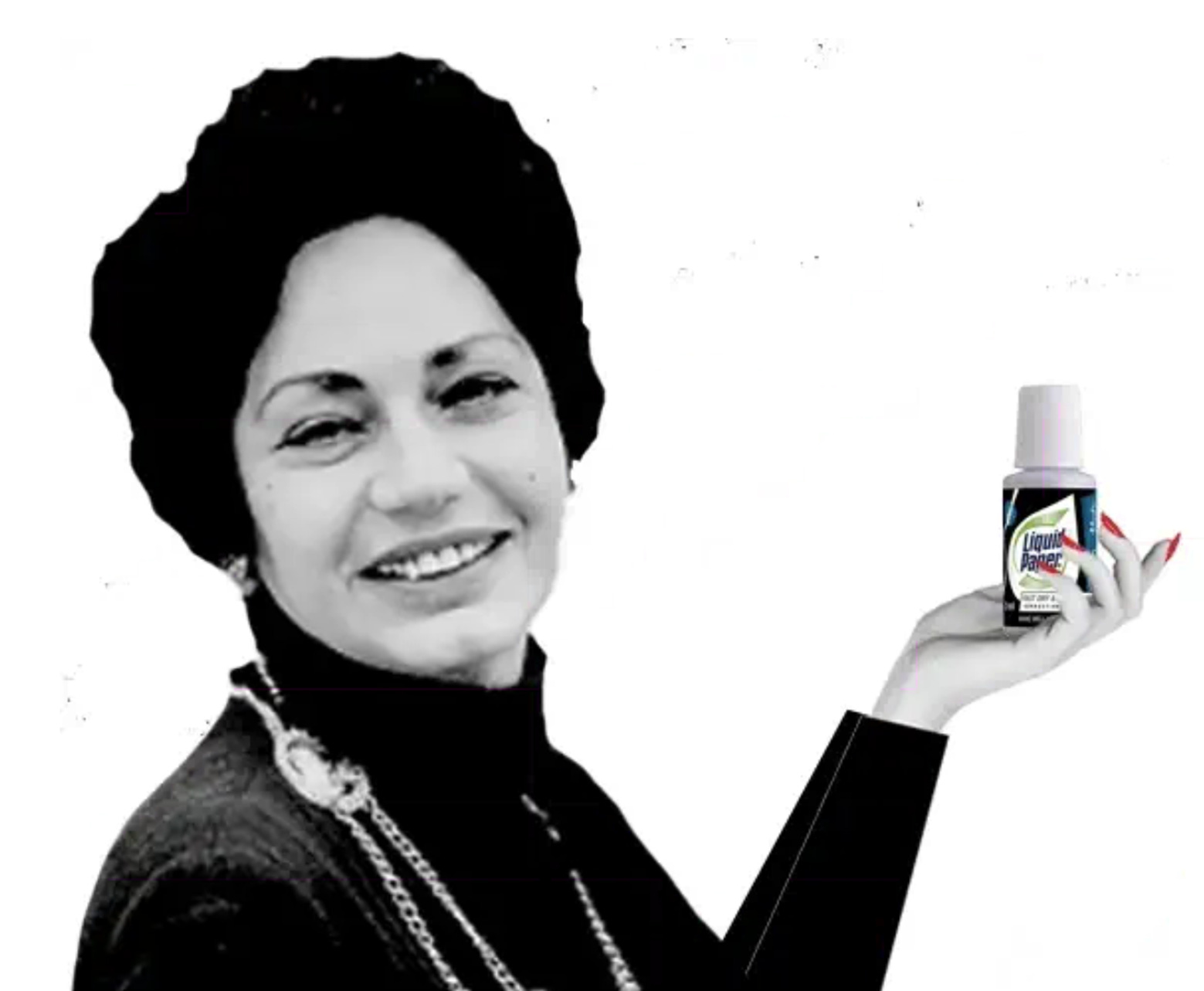
Where most would consider it defeat, she did not. Instead, she focused full time on her growing side business. She renamed the product Liquid Paper and formally incorporated it as the Liquid Paper Company. By the 1960s, she remarried, had employees, machinery, and national distribution. By 1968, the company was producing millions of bottles a year.
How revolutionary is that? A single mother, former secretary working out of her kitchen built a manufacturing company in the American South during a time when women could not even easily obtain business loans without a male co-signer.
What makes Bette’s story powerful is not just the money or even the success of her product. It is the mindset. That determination to succeed and believe in yourself as well as your product at that time in history should be applauded.
She did not invent something startling like microwave ovens or VCRs. She solved a daily frustration that millions of working women experienced but were expected to endure silently. Because it was not an issue for men, they did not need to consider fixing it. It needed a woman in the typing pool to solve the problem. And Bette did. She made imperfection manageable. She gave people a second chance on the page. And her invention gave her a second chance in life.
But she didn’t stop there. After she sold the business in 1979 to Gillette for $47.5 million, she took that money and reinvested in other women. After selling the company, she funded initiatives that supported women’s causes and arts programs. Helping other women succeed as well. (A small aside, her only son, Michael Nesmith, grew up to become one of the Monkees.)
One of the women who appreciates her invention is me. Liquid Paper lived in my pencil cases throughout high school and university; my children use it today. And it thrills me to know it was invented by a woman.
I read that same article--and fell in love with Bette. In a very early draft of my novel (a segment I later cut) I actually had one of the characters using Liquid Paper as a tribute to Bette. Thanks for introducing Bette to a broader audience!
Yeah!