


Nella Larsen became a writer later in life, but she came with a determination and unique perspective that she wove into her work with exactness and brilliance. She was able to approach the racial divide with elegance and accuracy, having her biracial characters move between the worlds with purpose. She was a master at writing psychological precision making her way ahead of her time.
Nella Walker was born in Chicago in 1891 to a Danish mother and a West Indian father who abandoned her early, which made her a Black child in an all-white household. Nella grew up not belonging to any world, she was completely ignored by one and reluctantly included in another. This became the basis for all her future writing.
Her mother later married a Danish man whose last name she adopted: Larsen. Together they moved back to Denmark. Larsen spent three years there where she stood out for being mixed race but still managed to make good memories like playing Danish children’s games she would later write about. When they moved back to Chicago, she settled into in a city thick with racial tension, as Black and European immigrants competed for jobs and housing.
Her mother, wanting more for her, pushed her toward education, sending her at Fisk University in Nashville in 1907. This was her first time living within a Black community, but she still felt like an outsider. She ended up getting expelled, most likely for breaking one of Fisk’s strict conduct rules, and she headed back to Denmark on her own for another three years. When she finally returned to the U.S., she chose to live in New York.
In 1914 she decided to enroll at Lincoln Hospital and Home in New York, one of the few institutions that would accept Black women into its nursing program. Armed with a degree, she went on to work at Tuskegee Institute in Alabama. Tuskegee did not suit her. The rigid social hierarchies along with its paternalism and suffocating rules on how a Black woman should comport themselves, railed against everything she stood for. She quickly left and returned to New York, where she worked as a nurse and later as a librarian, quietly educating herself in literature and ideas while the Harlem Renaissance began to emerge and influence her.
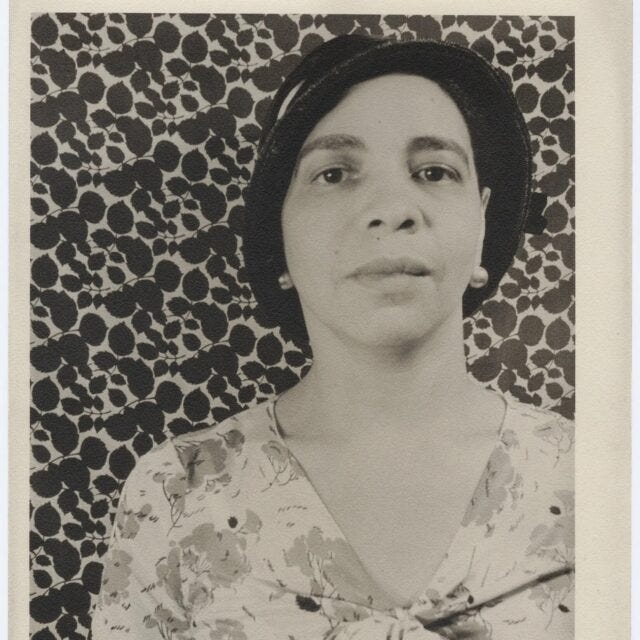
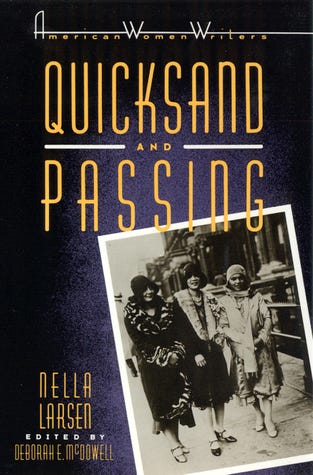
She married Elmer Imes in 1919. He was an impressive and prominent physicist; the second African American to earn a PhD in physics. A year later, after studying the great literature being produced in Harlem, she decided to try her hand at writing. Her first novel, Quicksand came out in 1928 quickly followed by Passing in 1929.
Quicksand follows Helga Crane, a biracial woman who moves restlessly between Black and white social worlds, between America and Europe, between one life and another, unable to find peace in any of them. Passing is tighter and more unsettling: two light-skinned Black women reconnect after years apart, one of them living openly as Black, the other passing as white and married to a man who doesn’t know the truth. The tension between them is erotic, competitive, and fatal. A film was made by Rebecca Hall in 2021 based on Nella Larsen’s novel. You can watch it on Netflix.
The Harlem Renaissance produced a large body of groundbreaking literature that was conscious of its audience, making an argument for Black dignity and humanity to dubious white readers and critics. Larsen wasn’t interested in that. Her characters were not representative of their race. They were unique, often unlikeable women navigating a world that gave them no room, they made poor decisions, felt shameful desires, and sometimes destroyed themselves as well as each other. This was revolutionary for its time. She crossed boundaries with ease, as did her characters and she did it unapologetically but with intent.
In 1930, she was the first Black woman to win a Guggenheim Fellowship for creative writing. From there she went on to Spain and France to work on her third novel, which never transpired. It’s not entirely clear why she never produced it but in 1930 she was accused of plagiarism after publishing a short story called “Sanctuary.” This story bore similarities to a short story by British writer Sheila Kaye-Smith. Larsen argued that she had heard about the story only through conversation but never read it. Several people jumped to her defense and believed that with her obvious talent, she did not need to plagiarize anyone, but the accusation hit hard. She was a Black woman in a literary world that was mostly white, and in that environment, accusations stuck even when they weren’t true. For Nella Larsen, the confidence required to go on writing in public after that kind of scrutiny was too much.
After the accusation, things started to decline for her. Her marriage had been deteriorating for years, and they finally divorced in 1933. Back then a life for a divorced Black woman was difficult both socially and financially. The women who flourished in the Renaissance generally had the support of husbands, institutions, or patrons but Nella Larsen now had none of them.
With her literary pursuits looking dismal, she went back to her original career in nursing with renewed vigor. She had no intention of writing again and with this difficult decision behind her, she became dedicated to her nursing career, She worked at several hospitals in New York, eventually becoming a supervisor at Gouverneur Hospital on the Lower East Side. She was quite skilled at her job and respected by her colleagues. And being true to her word, she never published again.
Tragically, she died alone in her apartment in 1964. With no family nearby she wasn’t found for several days. Her literary career was all but forgotten by this time and her death went without much fanfare. Her novels had been out of print for years and not widely read. The Harlem Renaissance had been only patchily recovered by literary scholars at that point, and within it, the women were recovering more slowly than the men. She died in obscurity, which is a terrible shame.
However, in 1970s she was rediscovered by scholars like Mary Helen Washington and Deborah McDowell who brought Larsen back into the forefront. Passing in particular turned out to be a remarkable text for thinking about race as performance, about the instability of identity classes, about the relationship between racial and sexual offenses. The novel that felt like a period piece was actually still relevant and impactful.
Her characters pass as white because the world they inhabit makes whiteness a form of survival. Larsen herself passed through the literary world, left it, returned to the work she knew, and was only recovered after her death. It’s a shame she was lost for so many years.
If you’d like to read more about Nella Larsen, you can read the NY Times obituary here. I was dismayed I didn’t find a site dedicated to her but you can read more about her work at Britannica and see her list of novels at Penguin. If anyone wants to start a fan site or create a society dedicated to her life and work, I’d love to know about it.
Amazing story…
Okay, this one I'm going for the movie. My reading stack grows with every article you write. This story makes me sad on many levels. Thank you for shining a light.