


There is a sentence that resonated with me once I started researching Peg Bracken, “This book is for those of us who want to fold our big dishwater hands around a dry martini instead of a wet flounder, come the end of a long day.” Peg Bracken wrote that in 1960, and I can’t stop thinking about it every time I walk into the kitchen to make dinner now over sixty years later. Because I’d much rather have a nice glass of wine and read a book than cook yet another meal after working all day. Peg Bracken was onto something.
Bracken was born Ruth Eleanor Bracken in Filer, Idaho, in 1918, and she grew up in St. Louis with apparently enough midwestern good sense to understand, from a very early age, that pretending to love something you don’t is one of the more exhausting things a person can do. She graduated from Antioch College in 1940, moved to Portland, Oregon, renamed herself Peg (her previous nickname, “Poots,” had not been received warmly by the literary establishment, which, fair), and got a job as an advertising copywriter. It clicked. She was funny, she was sharp, she understood exactly how language could be used to sell people things they already wanted, and she had a front-row seat to the single most aggressively marketed lie of the postwar era, the happy homemaker who adored her kitchen the way other people adore their children. Bracken knew this woman was a fiction as she was living proof.
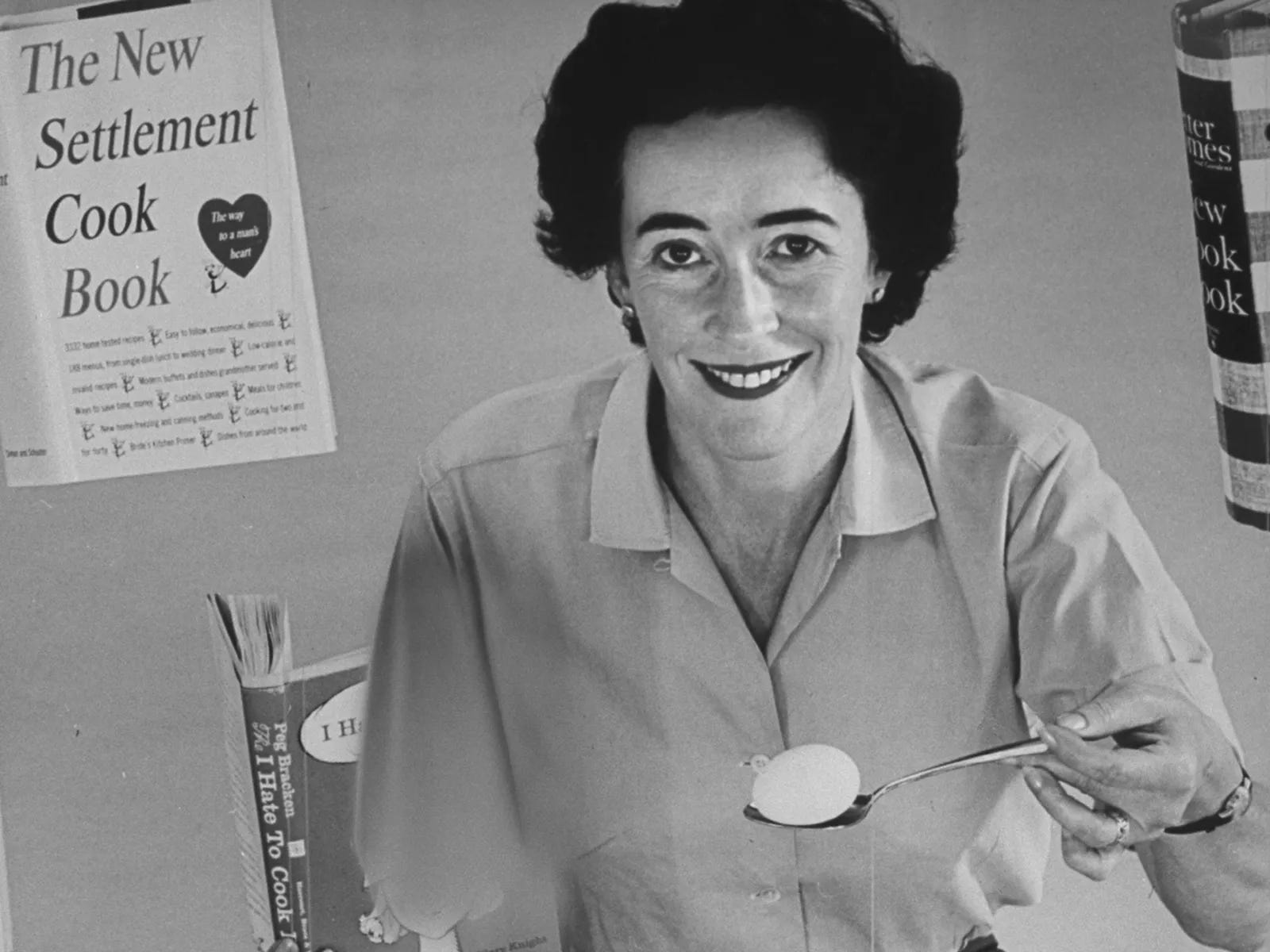
At home, she was doing what most women of her era were doing (including my mother), working, managing a household, raising a child, and cooking dinner every night for people who expected it without thanking her for it. The gap between what she was supposed to feel about all of this and what she actually felt grew so wide she eventually could not look away from it. So she did what writers do. She talked about it with her friends.
The friends called themselves the Hags, which is the kind of self-deprecating defiance that women of a certain era turned into an art form. Over lunch (and, one strongly suspects, multiple martinis), they pooled what Bracken cheerfully described as their “shabby little secrets,” the canned soups, the frozen vegetables, the boxed mixes, the shortcuts they’d been quietly deploying for years while their women’s magazines printed recipes for dishes that required three hours and the patience of a medieval monk. They swapped these recipes. Bracken wrote them down. She wrapped everything in her signature voice, which was dry and warm and wickedly funny and completely unwilling to pretend that cooking dinner was the highlight of any reasonable woman’s day. She called a chapter “Company’s Coming, or Your Back’s to the Wall.” She named a recipe Stay-a-Bed Stew. She told readers to stir the pot for five minutes while they lit a cigarette and stared sullenly at the sink.
Then she sent the manuscript to six male editors. All six rejected it. The reasons given were not subtle. Women, these men explained, regard cooking as sacred. Women would not want to read a book that spoke ill of it. Her husband at the time helpfully declared the manuscript stank. She eventually divorced him.
What strikes me about this particular chapter of the story is how perfectly it illustrates the way gatekeeping works. These men were not evaluating a bad book per se. They were evaluating a book that made them uncomfortable because it contradicted the very image of domestic femininity that their entire industry had spent a decade carefully constructing and selling back to women. A book that said, clearly and without apology, that women had inner lives that did not revolve around the dinner table or their man. That was the dangerous thesis none of them could commission or wanted to believe.
Finally, a female editor (who is unfortunately unnamed! I searched for ages to try and find the editor’s name unsuccessfully, so if you know, please tell me!) at Harcourt, Brace & Company saw it for what it was and bought it for $338. That is just over three thousand dollars in today’s money. It is an absolutely embarrassing advance for a book that would go on to sell three million copies, but it was enough.
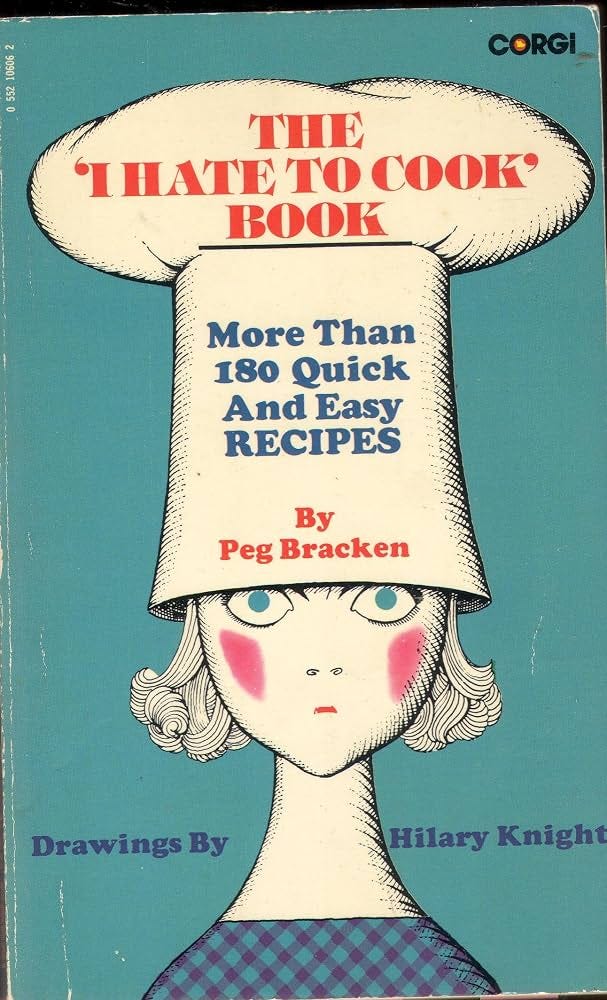
The I Hate to Cook Book was published in 1960, illustrated with whimsical line drawings by Hilary Knight, the artist behind the Eloise books, which was exactly the right tone. It sold 85,000 copies in its first two years and kept selling. Women bought it for themselves and for their friends. They passed it around. They wrote their names in the margins. A New York Times piece written after Bracken’s death observed that she had offered women “at least a taste of liberation from the oven, the broiler, and the stove” three years before Betty Friedan published The Feminine Mystique and the women’s movement had language for what it was liberating women from. Bracken didn’t have the language either. She had something more immediately useful, which was permission.
Permission to dislike cooking and do it anyway, quickly and without ceremony, to use cream of mushroom soup as the foundation of a meal and call it dinner (something my mom did – tuna casserole anyone?), and permission to close the recipe book at the end of a long day and pour a drink instead (more my style than my mom’s!).
Now, not everyone was pleased about this. James Beard, the grand patriarch of American culinary snobbery, considered Bracken and her canned-soup constituency “the enemy camp.” This is extremely funny if you think about it for more than two seconds, because Beard and Bracken were, in a purely technical sense, doing the same thing. Both championing an approach to food, both writing books about it, both eventually becoming spokespersons for Birds Eye frozen foods. Yes, that’s right. James Beard also did the Birds Eye ads. The man who considered Bracken the enemy of civilization was hawking frozen peas on television right alongside her. I would like to think that somewhere, Bracken was aware of this and that it made her laugh. That sad part is Beard is the gold standard for cookbooks and Bracken is a footnote.
The cooking establishment of the early 1960s was in the middle of a kind of arms race of culinary complexity. Julia Child’s Mastering the Art of French Cooking came out in 1961, and it is a magnificent book, but it is also a book that assumes its reader has three hours, a good knife set, and a fairly forgiving relationship with butter. Bracken was writing for a different woman entirely, the one who’d been at a job all day and came home to find that dinner was not, in fact, going to make itself. She had no patience for culinary snobbery and said so. She also had no patience for the growing food-world culture of treating a recipe as an occasion for performance and a dinner party as a referendum on your worth as a human being.
What she produced instead was practical, funny, and oddly radical. The book has chapters on last-minute suppers, company dinners, luncheons you can survive. The recipes were unfussy and the instructions were direct. She was not above telling you to open three cans and combine their contents, and she said it with a straight face that the result is very good, and she was right, because she was not, as at least one critic has observed, someone who actually hated cooking so much as someone who hated the theater of it, the expectation that it should be the center of a woman’s emotional life.
After the cookbook’s success, Bracken kept writing, The I Hate to Housekeep Book in 1962, an etiquette guide, an appendix to the original cookbook, a travel memoir, a proper memoir called A Window Over the Sink in 1981. She became a TV personality. She wrote columns for magazines. She kept working into her seventies, publishing her last book in 1997, at which point she was nearly eighty and still, by all accounts, still hating to cook. She died in 2007 at eighty-nine.
But before the Hags, before the martinis and the manuscript, Bracken was doing something else that was equally fun. She was sitting in an ad agency in the creative department writing a syndicated comic strip with a man named Homer Groening (father to The Simpsons creator Matt who based the Simpsons father on his own). What this means, if you follow the thread, is that the woman who gave a generation of wives permission to hate cooking was, in her earlier career, collaborating with the father of Homer Simpson. The universe has a sense of humor about domesticity and I am here for it.
The strip they collaborated on was called Phoebe, Get Your Man, and it starred a young woman desperately angling for a husband, which was its own kind of satire of the era’s expectations, though whether Bracken was being sincere, ironic, or both is a question she never seems to have answered directly. What it shows is that she was doing something sharper than copywriting from the start: she was writing about women navigating the social machinery built to contain them, and she was doing it in a form that was funny enough to be syndicated. I couldn’t find the strip itself so if anyone can, please share! The comic strip was short lived, unfortunately. But Bracken turned to back to her own writing. The I Hate to Cook Book was not, in that sense, a departure. It was the same project in a different kitchen.
The fiftieth anniversary edition of The I Hate to Cook Book was published in 2010 with a foreword by her daughter Johanna, and the book has been in and out of print ever since. It deserves more than it gets. Not because the recipes have aged particularly well (some of them are the product of an era that had a complicated and unfortunately devoted relationship with Jell-O), but because the voice is still startling. Bracken sounds like someone you’d want to eat dinner with, quickly and without fuss, over a cocktail she’s already concocted.
What she understood was that telling the truth about what women’s lives actually felt like was not an insult to women. It was a relief. The women who bought her book in 1960 were not buying it because they were lazy or unambitious or indifferent to feeding their families well. They were buying it because someone had finally said out loud what they’d all been thinking, and had made it funny, and had handed them a few practical tools to make their lives (and dinners) easier.
That was revolutionary!
You can read more about Pat Bracken in a NY Times Magazine profile here. She appeared on To Tell The Truth in1962 which you can watch HERE. She is at 9:50 minute timestamp. There is also a great article on how she tried to keep women out of the kitchen from the Persistant HERE. And finally, you can read a great article from Bon Appétit on why her book continues to be relevant HERE. Check her out, she’s worth it.
The Homer Simpson connection is truly worthy of a Netflix adaptation!
Terrific article - I never knew this book or Peg Bracken existed. What a great story!