


Shirley Jackson wrote one of the most disturbing short stories in the history of American literature and the literary world decided she wasn’t a real writer. The fact that she was one of the sharpest, funniest, most formally inventive writers of the twentieth century was treated as a secondary concern by the people who were supposed to know better. They disrespected her and relegated her to a footnote when they should have been paying her more attention.
This is the story of how that happened, why it was wrong, and why it matters that we correct the record.
Shirley Hardie Jackson was born in San Francisco in 1916 to a family that was hard, judgmental, oppressive and exhausting. Her mother, Geraldine, was a woman with strong opinions about beauty, femininity and the fact that her daughter possessed neither. The correspondence between them is the kind of reading that makes you want to lie down quietly in a dark room and be thankful for your own mother. Geraldine Jackson spent decades writing to her daughter about her weight, clothes, housekeeping, and her general presentation as a woman in the world with such determined consistency that would have been admirable had it been directed at literally anything else or had she been even remotely supportive of her daughter.
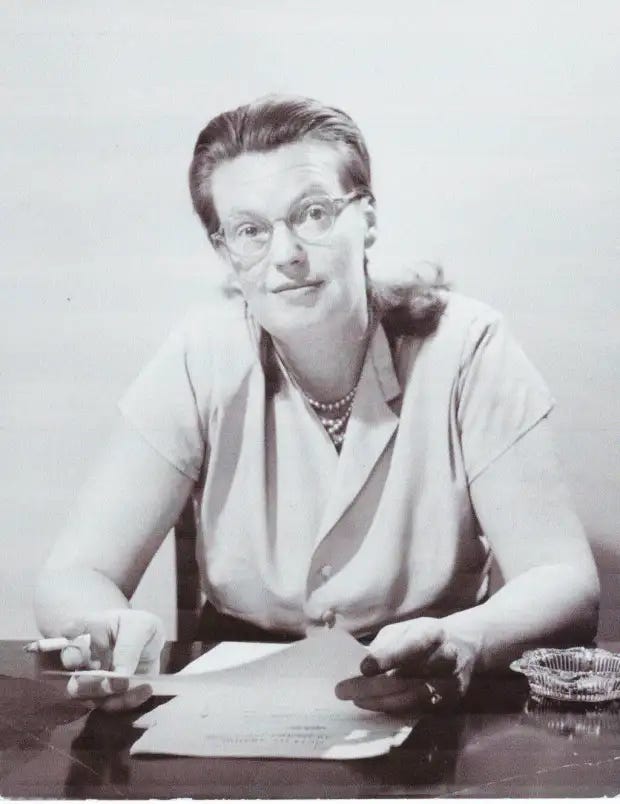
Jackson’s relationship with her mother cast a long shadow over everything she wrote. The mothers in her fiction are not warm and the houses are not safe which mirrors her own childhood. In Jackson’s writing the domestic sphere that mid-century American culture cast as woman’s natural habitat becomes a place where something deeply strange lurks just behind the facade of normal. This was purposeful and effective for her writing.
She went to Syracuse University, dropped out, went back, and there met Stanley Edgar Hyman, a brilliant, charming Jewish intellectual from Brooklyn who was frequently unfaithful, and comfortably secure in his own importance. They married in 1940. The marriage has been argued over endlessly by critics and biographers, some generous to both sides, most not. But it all comes back to the same uncomfortable question, what did it actually cost Jackson to be married to a man who thought he was the intellectual heavyweight of the household when she was clearly the better writer?
The Hymans moved eventually to North Bennington, Vermont, a small college town of the kind that has strong opinions about who belongs and who does not. Jackson was an outsider in every respect. She was too New York for the locals, too domestic for the New York intellectuals, too weird for the housewives, too female for the critics. She had four children in relatively rapid succession. She had a house that was perpetually overcrowded with books, cats, children, and visiting academics. She cooked, cleaned, shopped, managed the household and children but made time to write. The writing happened around and in the chaos of everything else, which meant that what she produced in those years was accomplished under conditions that most male writers of her era could not have survived nor been able to create.
This matters because Jackson did not write in spite of her domestic life. Instead she wrote through it, from it, and against it. Her two memoirs, Life Among the Savages (1953) and Raising Demons (1957), are ostensibly comic accounts of life with children and a large, chaotic house.
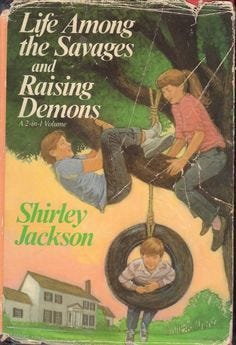
Her books were published as domestic humor, marketed as domestic humor, reviewed as domestic humor, and sold very well as domestic humor to the women’s magazine audience that was considered the natural readership for that kind of thing. Critics who were looking for Important American Literature did not read in this space therefore she was overlooked as a serious writer. But she was beloved by the women of that era. My grandmother, who had seven children, and my own mother, who had four children both thought Shirley Jackson was fantastic. I distinctly remember my grandmother stating that how Ms. Jackson told many truths through her humor.
What those critics missed, and what readers who return to those books now are immediately struck by, is that Jackson is doing something considerably more interesting than writing charming anecdotes about funny things the children said. The domestic chaos she describes is rendered with the same quality of attention, the same sense that something ordinary has been tilted two degrees off its axis, that runs through her horror fiction. The comedy is real, but underneath it you get the sense of a woman watching her own life from a slight distance, someone who’s figured out that performing cheerful domesticity and haunting your own house aren’t actually that different. If you read Life Among the Savages and then her novel The Haunting of Hill House is a genuinely uncanny experience, not because they are the same book but because they are so clearly products of the same mind working on the same preoccupations from two different angles. This was something I studied as an undergrad in an English Lit class that showed how borrowing from real life can bring authenticity to fiction. This example has always stuck with me as it’s the perfect example for, “Write what you know.” But Jackson gave it a twist.
In June of 1948, The New Yorker published The Lottery, and the American reading public collectively lost its mind. Jackson received more mail in response to that story than the magazine had received in response to anything it had ever published, and the majority of it was somewhere on the spectrum between baffled and furious. Readers cancelled their subscriptions. Readers demanded to know where this lottery took place so they could avoid going there. Readers accused Jackson of being sick, disgusting, Communist, and anti-American. A smaller number wrote to say the story was extraordinary and they would like more of the same immediately.
What The Lottery did, and what still makes it work seven decades later, is perform a very precise piece of surgery on the idea of community. It presented a village ritual, describes it in a flat, procedural tone that initially makes it sound like a town fair, and then reveals it to be a public stoning, all without explaining itself, apologizing, or softening the landing. The horror of the story is not the violence. The real horror was how normal it all was. How the women gossip beforehand and the men make jokes and the children collect stones and the whole thing proceeds with the smooth, unconscious efficiency of something that has been done so many times it has become simply what one does. Jackson was writing about conformity, about the violence embedded in consensus, about what happens when a community decides that its traditions matter more than the people those traditions are enacted upon. She was writing, in other words, about something that had nothing whatsoever to do with the supernatural. It is a fantastic story and holds up well even today. Go read it!
This is the central irony of Jackson’s reputation which was sketchy at best. Her most famous work, the work that made her name, is not a horror story in any conventional sense. It contains no ghosts, no monsters, no haunted houses. It is a piece of psychological and social realism so precise that it feels like being cut with a very clean blade. The fact that it got filed under “horror” and “the macabre” says a great deal about how critics processed work by women that made them uncomfortable, and very little about the work itself.
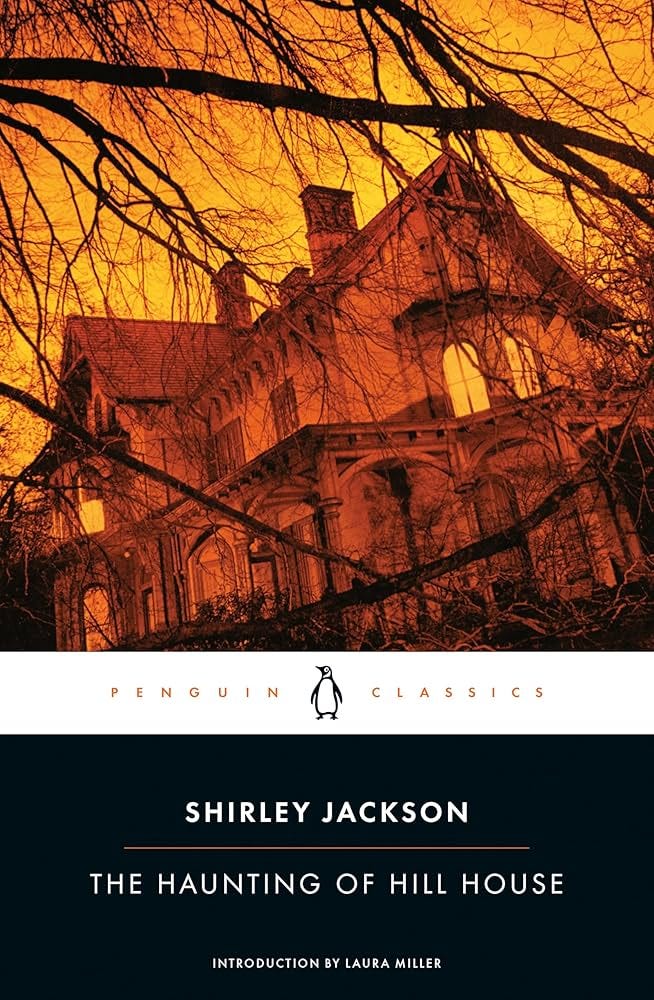
The Haunting of Hill House was published in 1959 and is, in my humble opinion, one of the greatest American novels of the twentieth century. It opens with one of the most discussed first paragraphs in modern fiction, a paragraph about the house standing alone and holding darkness, which has the quality of something that sounds like a description of a building but is actually a description of a mind. This is not accidental. Jackson spends the entire novel doing exactly this, writing about Eleanor Vance, a repressed, lonely woman in her thirties who has spent her adult life caring for an invalid mother and has never, not once, had a life that was properly her own, through the medium of writing about a house that may or may not be genuinely supernatural.
The genius of the novel, and the thing that separates it from straightforward ghost stories, is that it never resolves the question of whether Hill House is haunted or whether Eleanor is. The phenomena that occur in the house could be genuine supernatural manifestations. They could also be projections of Eleanor’s disintegrating psychological state. Jackson holds both possibilities open simultaneously and refuses to arbitrate between them, which means that the horror of the book operates on two registers at once, the exterior horror of a wicked place and the interior horror of a woman who has been so thoroughly denied interiority by her circumstances that when she is finally given space to feel things, what emerges is catastrophic.
Eleanor is one of the great portraits of a particular kind of female longing in American literature. She wants a house of her own. She wants to belong somewhere. She wants, in the most fundamental sense, to exist as a self rather than as an appendage to other people’s selves. Hill House, which is terrible and seductive in equal measure, offers her all of this, and the price it extracts is everything. Reading the novel as horror is entirely legitimate. Reading it as a precise and devastating account of what happens to women who are never allowed to take up space is equally legitimate. It’s an extraordinary piece of literature.
The critical reception in 1959 was warm, sometimes genuinely enthusiastic, but the enthusiasm was measured. Jackson was praised for her ability to create atmosphere and for her skill at depicting “the macabre.” She was not, in any consistent or serious way, discussed as a novelist effectively using a set of formal strategies and obsessive preoccupations to say something true about what it is to be human. That conversation was happening elsewhere, about other writers, most of them men like Ray Bradbury, Kurt Vonnegut, and Truman Capote.
If Hill House” is the novel that gets taught in courses and cited in essays and adapted for screens, then We Have Always Lived in the Castle, published three years later in 1962, is the one that people who love Jackson tend to talk about with a particular quality of intensity, like someone describing a piece of music that affected them in a way they still haven’t entirely processed. It was published to positive reviews and promptly treated as a charming gothic entertainment. It won the National Book Award nomination, which was something. It was not discussed as the masterpiece it is. It took decades for the critical conversation to catch up.
The question of why Jackson was patronized during her lifetime has a reasonably straightforward answer, which is that she was a woman writing in a period when the literary establishment was comprehensively organized around male experience and male taste. The serious American novel, as defined by the critics who defined these things, was about the individual consciousness confronting society, about identity and alienation and the big themes. It was written by Bellow and Mailer and Roth and Updike, and it was reviewed by men who considered this tradition the main event. Women who wrote domestic fiction were writing domestic fiction. Women who wrote gothic fiction were writing genre. The idea that a woman could be doing both simultaneously, and that what looked like genre might in fact be a highly sophisticated formal strategy for addressing the same concerns as the canonical male writers from an angle those writers couldn’t access, was not a widely available thought in 1959.
There is also the specific problem of comedy. Jackson was very funny, and the funny work got her filed with Jean Kerr and Erma Bombeck, which was good company but not the company of people whose work gets treated as literature. The critical hierarchy that placed “serious” above “funny” operated against her in a way it did not operate against, say, S.J. Perelman or Joseph Heller, because men being funny in print were being funny on purpose as a literary strategy, whereas women being funny in print were presumably just describing things that happened to them.
Something has happened to Shirley Jackson’s reputation in the years since her death in 1965 that is both gratifying and somewhat overdue. Ruth Franklin’s biography, Shirley Jackson: A Rather Haunted Life, published in 2016, provided the comprehensive account that the work deserved and gave a generation of readers the context to understand what Jackson was doing and why it mattered. The Library of America collected her work. Netflix adapted “The Haunting of Hill House” into a series that bore a loose relationship to the novel but introduced the title and the creator to millions of people who then went and read the book. “We Have Always Lived in the Castle” has been re-evaluated by critics who are now willing to say that it is a masterpiece.
The conversation is happening. It is just happening fifty years later than it should have.
Shirley Jackson managed to produce a body of work created under conditions that would have silenced most writers, reviewed by critics who were looking in the wrong places for the wrong things, for an audience that was often the right audience even if the critical establishment couldn’t see it.
She deserved better from the people who got paid to notice. She has, belatedly, got it anyway. If you are a writer, reading her fiction and nonfiction is an excellent way to see how a master takes their reality and weaves it into gold by taking the ordinary and making it extraordinary by looking at it through a new lens. She was an amazing writer we could all learn something from! And her books and short stories are gold.
If you want to learn more about Shirley Jackson, you can find her writing here, and read more about her here and more about her in this New Yorker piece.
Loved reading this. I agree that she's funny! I just published a new post about We Have Always Lived In the Castle and partly about the hysterical humor in it.
I loved The Haunting of Hill House when I first read it long ago, and the late-night scene where Eleanor thinks she is holding her roommate's hand while they listen to the loud bangs and knocks on the doors and walls, then discovers the roommate is too far away and could not have been holding her hand--it still haunts me! I also loved the first movie they made, with Julie Harris, who captured the Eleanor from the book so perfectly. I also read and laughed through Life Among the Savages. She was definitely a brilliant writer.