

The $2.5 Million Question
What the latest AI scandal tells us about publishing, trust, and the writers who are about to pay for it

Here is what happened, for anyone who missed the week (although I doubt there are many!). A debut crime novel went to a fourteen-way auction. Fourteen editors, competing hard enough that Minotaur, an imprint of Macmillan, walked away with a two-book deal worth something in the neighborhood of two and a half million dollars. This is the kind of number that makes an agent’s whole year, the kind of deal that gets a debut author a profile, a film option conversation, foreign rights heating up before the ink is even dry. Publishers Marketplace covered it, The Guardian covered it, and everyone was thrilled. At first.
Then, three weeks into the submissions process, the editor flagged something. The writing had a particular cadence to it. Odd, over-symmetrical comparisons, flatness where you’d want a debut novel to be a little rough but alive and convincing. The agents, to their credit, spoke with the author, and had what they described as an extremely detailed conversation about authorship, where he denied AI use, and they chose to believe him.
Then more questions came. During a meeting on July 29th the story shifted enough that the agents declared they could no longer authenticity of how the manuscript had evolved from origin to completion. They immediately cut ties with the author. The deal that had made headlines a month earlier for being groundbreaking now made headlines for being broken. This was not good.
The author denies all of it. Mr. Falade has said, on the record, that he is completely innocent, that he has time-stamped drafts and dated messages that show the book’s development, and that the accusation reflects something uglier than craft suspicion, since he is a Black debut author and other Black authors have had major deals unravel under similar clouds this year. This is not a small detail to raise, and it deserves to be taken seriously rather than waved off as a convenient defense. I don’t know what happened in that manuscript’s history and neither does anyone writing hot takes about it this week. What I do know is that the conclusion everyone reached for to settle the question doesn’t actually settle anything
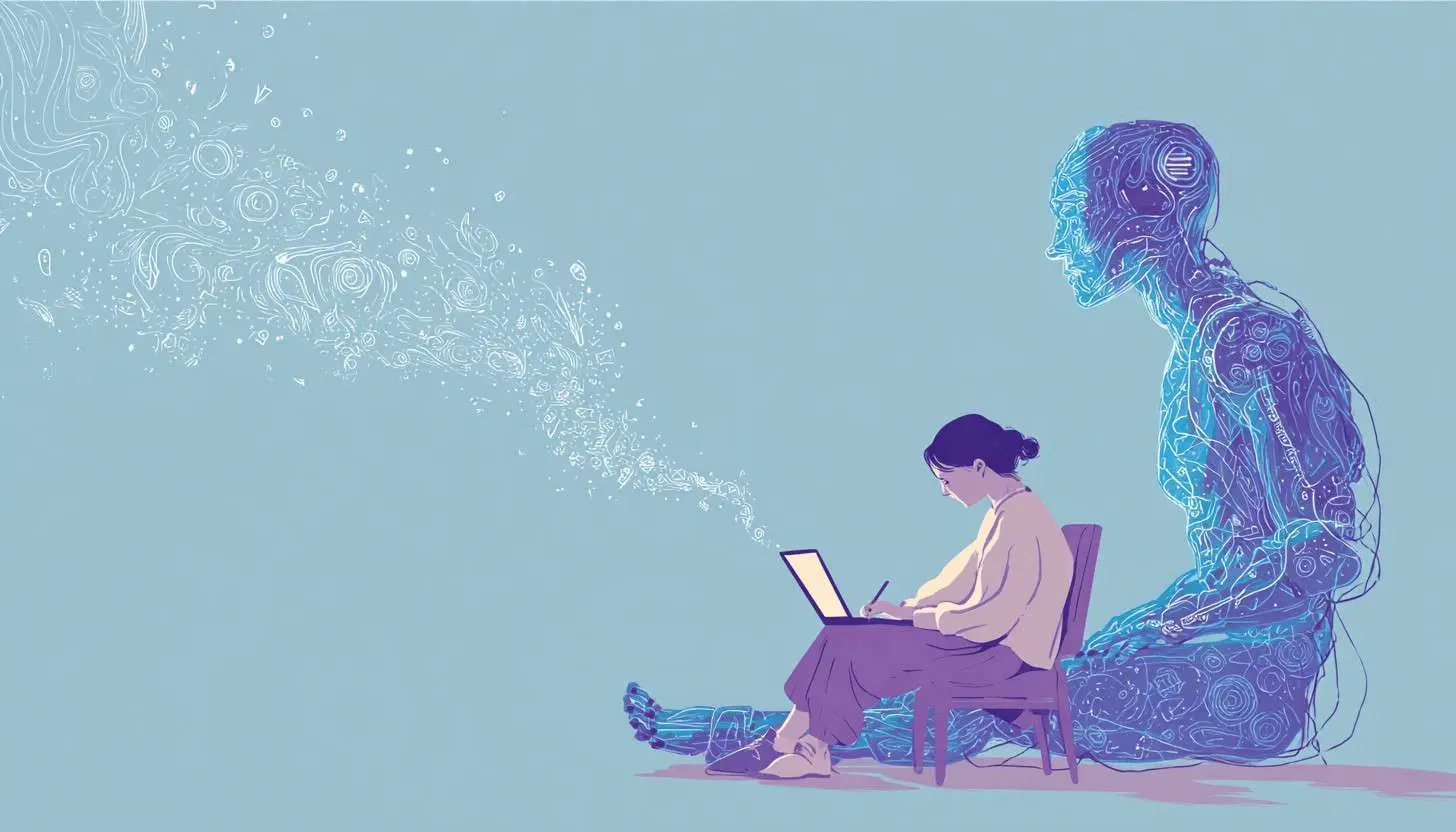
.
Kathleen Schmidt, who has been one of the clearest voices on this all year and someone I admire for her frankness, wrote something in her newsletter that made sit up straighter. She ran her own writing, her own newsletter, through Pangram, the AI-detection tool that Substack has now partnered with, and it came back as eighty percent AI. She wrote every word of it herself. Her point wasn’t that Pangram is useless in every case. It’s that a tool with that failure rate should never be the thing that ends a career, and yet that is exactly the role it is being asked to play, informally, by editors and journalists who feed manuscripts into it without the author’s knowledge or consent.
That detail matters more than it’s being given credit for. In the case of the debut novel that got Amazon-bestseller attention this summer, and in a separate case where a major publisher pulled a book after it scored high for AI content, the pattern was the same each time, someone outside the author’s own team ran the file through Pangram, got a number, and made that number public before anyone had a chance to ask a single careful question. Schmidt called this out plainly. Publishers are not being cautious here. They are being reactive, and reactive institutions build bad precedent fast.
Here’s the part that should worry every working and aspiring writer, not just the ones accused. If a tool returns a false positive on a professional publishing veteran’s own prose, it will return false positives on debut novelists whose voices are still finding their shape, on genre writers whose writing is built on rhythm and repetition as a stylistic choice, on writers whose first language isn’t English and whose sentence patterns don’t match whatever statistical fingerprint the model has decided counts as human. We are building an accusation machine before we’ve built a defense. And this is a dangerous precedent, in my opinion.
Brooke Warner made a keen observation, publishing doesn’t actually know what it thinks about AI, and that confusion is starting to show in public. Within the same week, one publisher stood behind a book that had been publicly accused of being AI-generated and let it ship on its planned date, while another publisher walked away from a seven-figure deal over suspicion alone, no confirmed proof, just suspicion. Two publishers, two entirely different responses to the same category of accusation, in the same month.
That inconsistency isn’t a minor embarrassment. It’s a signal to every writer watching that there is no actual standard here, just vibes and risk tolerance and whichever executive is most afraid of a bad news cycle that week. Ted Gioia put it more bluntly in a note that made the rounds, publishers have figured out that even a whiff of AI-generated slop is now toxic enough to kill a deal, and that alone should tell writers that transparency about their process is now in their own best interest. I agree with him on the transparency point. I disagree that we should wait for reputational fear to be the thing that fixes this, because fear-driven policy is exactly how you end up canceling the wrong author’s deal while a genuinely AI-assisted book sails through because nobody happened to run it through the checker that week.
Where I stand, plainly
I am a literary agent. I read manuscripts for a living, assess them, shape them, and put my name behind them when I submit them to editors. So let me say this without hedging, because I think hedging is part of how we got here.
I will not represent a novel that was written by AI. Not partially generated and lightly revised, not “assisted” in some way that blurs authorship, not run through a model to punch up the prose. If you used AI to write your fiction, I am not your agent, and I don’t think I should be. I think this needs to become an actual, stated, unembarrassed standard across the industry rather than something we all privately believe and publicly tiptoe around because we’re worried about seeming unwelcoming to new technology.
I also do not want to put any of my clients work into any AI machine in fear that it will then be a part of said machine and would be flagged in the future for plagiarizing itself.
Writing a novel is hard and it is supposed to be hard. The difficulty is not an unfortunate side effect of the process that we’re all trying to engineer away. It is the process. Every awkward first draft, every plot hole you have to maneuver and repair, every time you sit with a scene that isn’t working and have to actually think your way through matter. That is the work that makes a writer a writer. If you want to skip that work and still get the byline, the advance, and the author photo, I don’t think you want to be a writer. I think you want to have been one, which is a different and much smaller thing, and it is not something I am interested in helping anyone fake. Ever.
I know that’s a strong stance and I know some people reading this will think it’s unnecessarily harsh given how blurry AI use can get in practice, spelling and grammar tools, research assistance, brainstorming a plot hole out loud with a chatbot the way you might with a writing partner. I’m not talking about any of that, and I think most of us can tell the difference between a tool that helps you think and a tool that does your thinking for you. The line I care about is authorship. Did a human being make the sentences, wrestle with the structure, decide what this character would actually do in this moment because they understand that character, or did a human being prompt a system and then curate its output. Those are not the same act, and publishing should stop pretending the distinction is too hard to draw.
Carly Watters, who has been one of the more consistently outspoken agents on this, explained it plainly. She has said she is vehemently against writers using AI for creativity, that it dulls the writers instincts, the ones they need to develop, and that she genuinely doesn’t understand how someone can call themselves a writer if they aren’t doing the writing. I absolutely agree. I don’t think that’s gatekeeping for its own sake. I think it’s a defense of what the word ‘writer’ is supposed to mean, and I think agents who go soft on this out of a fear of sounding old-fashioned are doing their actual working writers a disservice.
What this does to the writers who didn’t cheat is the part that worries me more than the individual scandal does. Every one of these stories, whether the accusation turns out to be true or false, adds another layer of static and caution to a submissions process that was already brutal. Writers querying agents right now are starting to wonder, reasonably, whether the manuscript that got picked over theirs in a crowded inbox got there faster and cleaner because someone cut corners they refused to cut. And that makes me angry. That suspicion corrodes something real. It makes the debut writer who spent four years on a book and revised it five times start to resent the process itself, not because the process is wrong, but because they can no longer be sure everyone else is playing it straight. And that is just wrong.
And it cuts the other way too. Legitimate writers, writers who did every bit of the work themselves, are going to get swept up in false accusations because their prose happens to have a rhythm a detector doesn’t like, because they’re debut enough that nobody has a track record to point to, because someone with an axe to grind decided to run their file through a checker and post the number. Kathleen Schmidt raised this directly. There is real jealousy in this industry, and a tool like this, available to anyone with a grudge and a PDF, is going to be used exactly the way you’d expect.
So here is what I think actually has to happen, and I don’t think it’s complicated at all, even if it’s uncomfortable. Publishers and agents need to stop treating a Pangram score as evidence and start treating it as a prompt to ask better questions, drafts, dated files, a writing history that shows a book actually becoming itself over time rather than arriving finished. That kind of process transparency protects honest writers far better than a probability score does, and it puts the burden of proof somewhere sane instead of on a tool that flags its own inventor’s competitor at an eighty percent false positive rate.
And agents need to say, out loud, where they stand on AI-generated fiction, before they’re in the middle of a scandal and have to figure it out in real time under a deadline and a reporter’s phone call. I’ve told you where I stand. If that costs me a client who wanted to cut the line, I will take that trade every single time, because the alternative is an industry where nobody can tell anymore who actually wrote the book they’re about to spend two years of their career championing.
Writing is supposed to be the hard, slow, humbling thing that turns someone into a writer. If you’re not willing to do that part, maybe this industry is not for you.
I know this is going to make a few people angry. Good. It should. But taking a strong stance on this now will help us sort it out sooner rather than later, in my opinion.
Thank you for this post, Erin. I am one of those querying novelists who spent six years on my debut. After getting some nibbles but no bites, I stopped querying, addressed an r&r and now it’s with my developmental editor for the fourth time. I’ve invested a lot of time and money, and that’s okay. As you said, writing is hard. I’m learning. It’s a business expense. But all of these authors getting cancelled, their careers ended before they’ve even started, on “suspicion” makes me feel like self-publishing is a safer route. I trust myself to usher my baby into the world and make sure she thrives.
Strong and excellent stance in a sad and terrifying new world of problems. I do not understand why a writer would let anyone or anything else do their thinking. I call it the Holy Process because that’s how it feels sometimes when my brain strains or tinkers with a storyline problem and then rewards me with a solution. It’s that creativity that IS THE REWARD of writing.